sales@bonporaparts.com
0086-10-64988621
English
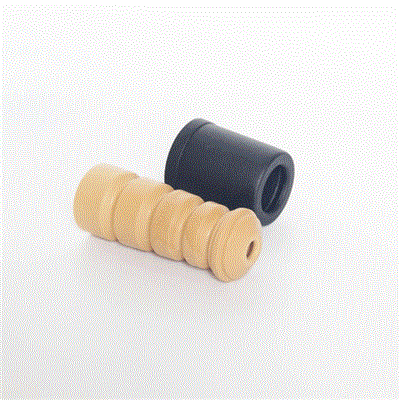
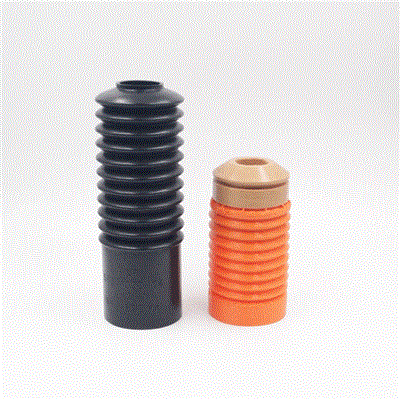
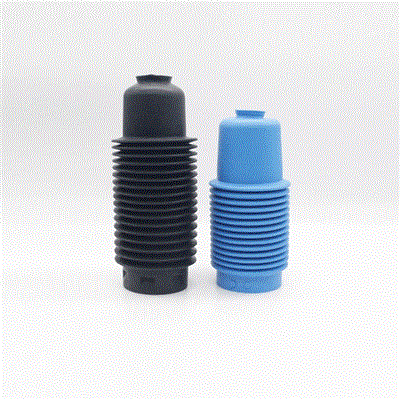
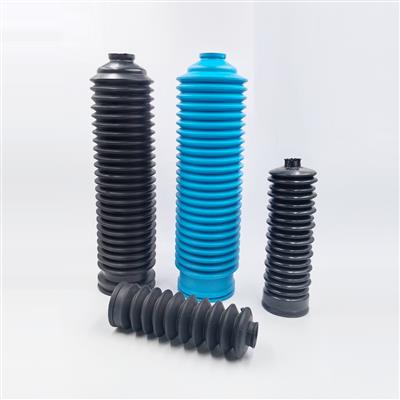
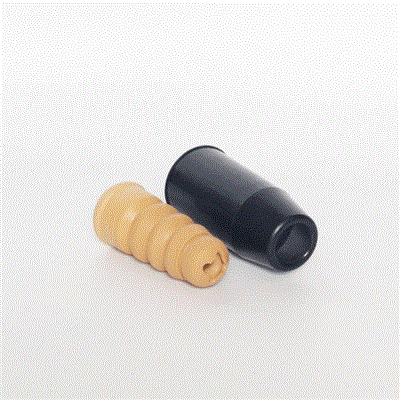
Dust Cover (also called shock dust boot, dust shield, or strut bellow) is installed externally on the shock absorber piston rod, positioned above the oil seal. Its upper end mates with the piston rod, and its lower end mates with the reservoir cylinder or connecting component. It is made from EPDM, nylon PA66, PU, NR, NBR, TPE and similar compounds.
Functions: it prevents external contaminants such as mud, dust, and moisture from reaching the oil seal and the piston rod surface, avoiding scratching of the piston rod and damage to the oil seal. It also helps block high temperature and UV ageing.
Service life: design life of no less than 5 years or 80,000 km, without cracking, hardening, or deformation failure under conventional environmental conditions.
Quality warranty and standards:
Quality standard: complies with IATF 16949 system requirements. Test items include hardness, tensile strength, ozone resistance, and high and low temperature resistance from -40 C to +100 C.
Warranty information: warranty is provided with the complete shock absorber assembly. When sold separately, a 1 year or 50,000 km warranty is offered, covering material and manufacturing defects.
Customization (samples and drawings accepted): moulds can be customized based on customer supplied mounting dimensions, shape, and colour. Different bellows profiles and material hardness adjustments are supported.
The dust cover is the cheapest part in a damper assembly and one of the most valuable, because it protects the two components that decide whether the damper keeps working: the piston rod surface and the oil seal. The rod relies on a fine surface finish to let the seal wipe oil evenly as it travels. Once abrasive grit reaches that surface, the rod is scratched, the seal lip wears, and oil starts to escape. Performance fades long before the vehicle reaches a workshop.
That sequence explains why a torn boot is worth fixing quickly. Water and dust enter through the split, the seal runs dry and dirty, and the failure moves from a low cost rubber part to a full damper rebuild. Buying a replacement boot is a small cost compared with replacing the rod and seal set.
This guide is written for parts buyers and workshop engineers who need to specify, cross reference, and replace dust covers with confidence. If you are ordering related damper components at the same time, our shock absorber parts range covers the common rebuild items.
Buyers run into trouble because the same part is sold under several names, and the names are often used loosely.
Dust cover is the general term for the external flexible sleeve that shields the rod.
Shock dust boot usually refers to the same sleeve on a shock absorber, and the word boot tends to appear in aftermarket catalogues.
Dust shield is used for both a flexible sleeve and a rigid shield, so confirm whether the part flexes with the suspension or is fixed.
Strut bellow describes the corrugated sleeve fitted to a MacPherson strut, where the cover also protects the strut bearing area.
When you request a quotation, describe the mounting rather than assuming a name is enough. A photo of the installed part plus the rod and cylinder diameters removes almost all ambiguity.
Material choice drives service life more than any other decision. The right grade balances flexibility at low temperature, resistance to ozone and UV, abrasion resistance against road grit, and cost.
| Material | Practical temperature range | Weather and ozone | Abrasion | Oil resistance | Typical use |
|---|---|---|---|---|---|
| EPDM | About -40 C to +120 C | Excellent | Good | Poor | General road cars, the usual default grade |
| NBR | About -30 C to +100 C | Moderate | Good | Very good | Applications with oil mist nearby |
| NR | About -40 C to +70 C | Moderate | Good | Poor | Cost sensitive low temperature duty |
| PU | About -30 C to +80 C | Good | Very good | Good | High abrasion duty, stone chip exposure |
| TPE | About -40 C to +100 C | Very good | Good | Moderate | Colour matched covers, clean appearance |
| Nylon PA66 | About -40 C to +120 C | Excellent | Excellent | Good | Rigid shields and protective collars |
The ranges above are orientation only. Elastomer suppliers adjust formulations, and a fillers and plasticiser package can shift the practical window considerably. Always confirm the grade against the operating temperature range of the specific vehicle, and remember that a market with severe winters needs more low temperature flexibility than the same vehicle sold in a mild climate.
EPDM remains the most common choice for road vehicle dust covers because it handles ozone, UV, and weather well at a reasonable cost. PU appears where stone damage is a real risk. Nylon PA66 is normally used for a rigid shield rather than a flexible sleeve, so it does not replace the boot itself.
The corrugations, or convolutions, allow the cover to extend and compress with suspension travel without stretching the material permanently. A cover with too few convolutions must stretch more on each cycle, and it cracks earlier at the folds. Too many convolutions can bunch together at full compression and rub against each other, which also causes wear. The profile should match the actual stroke of the damper rather than a general size.
Wall thickness sets the balance between durability and flexibility. A thin wall flexes easily but punctures on stones, while a heavy wall resists damage but stiffens at cold temperatures. Some designs include a small breather feature or a loose fit at one end so that air moves in and out as the cover works, instead of the sleeve inflating and collapsing like a pump. That detail is easy to overlook and is a common reason a cover splits near the clamp.
The upper end usually grips the piston rod or the top mount, and the lower end seats on the cylinder body, a spring seat, or a dedicated groove. Gripping can be achieved by an interference fit on a bead, a wire ring, a plastic collar, or a cable tie. The fixing method has to hold through years of movement without cutting the rubber, so a sharp edge under a clamp is a frequent cause of early failure.
A dust cover is a soft part, which makes measurement feel forgiving, but the fit still has to be correct at both extremes of travel. Measure the damper, not a similar looking part from stock, and write the following values on the drawing.
| Dimension | Why it matters |
|---|---|
| Piston rod diameter | Sets the upper fixing diameter and the grip without cutting |
| Cylinder or seat diameter at the lower end | Sets the lower fixing and prevents the sleeve riding off |
| Extended length under full droop | Confirms the cover can reach without taut stretching |
| Compressed length under full bump | Confirms the convolutions do not crush or jam together |
| Free length fitted state | Defines the natural shape at ride height |
| Clearance to spring and body | Avoids rubbing that wears through the wall |
| Colour and surface finish | Matches the assembly appearance requirement |
Where the cover sits close to a coil spring, check the clearance through the full steering and suspension range rather than at ride height alone. Rubbing marks found on a returned part usually mean the clearance was checked in the wrong position.
Failures follow recognisable patterns, and the pattern tells you whether the part was wrong or the application was harder than expected.
| Symptom | Likely cause | Practical response |
|---|---|---|
| Fine surface cracks across the crown of the folds | Ozone and UV ageing, or an unsuitable grade | Move to an EPDM or TPE grade suited to the climate |
| Hard, brittle material that snaps when flexed | Heat ageing or long service beyond design life | Replace the cover and check the damper for heat sources |
| Split close to the clamp | Sharp edge, over tight clamp, or trapped air pressure | Check the bead, the clamp type, and the venting |
| Tear in the wall | Impact from stones or contact with the spring | Consider PU, adjust clearance, or add a rigid shield |
| Cover detached from one end | Fixing method unsuitable for the stroke or contamination | Change to a positive fixing such as a collar or wire ring |
| Soft, swollen, or shiny material | Contact with oil, solvent, or a cleaning chemical | Change to an oil resistant grade and review workshop practice |
When a cover fails early, inspect the piston rod at the same time. A scratched rod or an oil film near the seal means the failure has already moved past the boot, and replacing only the cover will not restore the damper. The related piston rod range covers common sizes if a replacement is needed.
Replace the cover whenever it is split, cracked, or detached, because an open boot admits exactly the contamination it was fitted to exclude. Replace it during a damper rebuild even if it looks serviceable, since a new boot on a rebuilt damper costs little and protects the new seals. On a high mileage vehicle, treat the boot as a service item rather than waiting for a visible failure.
Design life is commonly quoted as no less than 5 years or 80,000 km under conventional environmental conditions. Severe dust, heavy salt exposure, or sustained high temperatures will shorten that period, so vehicles used in those conditions deserve a more frequent inspection. The same thinking applies across the chassis and suspension system, where rubber parts generally age faster than steel parts wear.
Aftermarket buyers rarely order by description. They order by original equipment number, so a supplier who can cross reference quickly wins the order. The tables below group the common references by brand family. Numbers are listed as supplied for matching purposes, and the correct part should always be confirmed against the vehicle application before ordering.
6N0413175A, 1JD413175, 1J0513425, 321513425, 357412135, 191513425, 4M0512137B, 8K0512137A, 95B412137, 99634350500, 99333310701, 99134350902, 98633350501, 971512137
A2053260098, A2113230092, A2123230392, A2033230092, A2043260598, E4-SR4-Z017A00, A2053230292, A1663230098, A1773235000, A2043230592, LR073344, LR024475, LR061354
51403-T2A-A01, 51686-TVA-A01, 51686-T7A-003, 52687-S5A-014, 51403-STK-A01, 52687-SFE-003, 52687-T0A-A01, 52688-TMJ-T02, 52688-THA-H02, 51686-SMG-E01, 54052-4M400, 55240-5EE0A
CN15-18159-AA, 7M51-3K036-AA, 9T4Z-18A047-B, F2GC-18159-AXB, GV9B-28-1A0, 6C11-3K036-AC, BCKE-34-015, 54625-2D000, 54625-08000, 54625-0Q000, 55370-1C000, 54628-38000, 55316-38600, 55325-2E00
Send the full vehicle details, including year, model, and suspension type, when you ask for a cross reference. Two vehicles with the same nameplate can use different strut and boot combinations, and a number match without a vehicle check is not a confirmed fit.
| Item | Detail to supply |
|---|---|
| Application | Vehicle make, model, year, and suspension type |
| Reference | OE number plus any aftermarket number in use |
| Dimensions | Rod diameter, seat diameter, extended and compressed length |
| Material and hardness | Preferred grade, or the operating temperature range if unspecified |
| Fixing method | Bead fit, collar, wire ring, or clamp |
| Appearance | Colour and surface finish requirement |
| Volume | Annual quantity, first order quantity, and packaging preference |
| Documentation | Whether a batch certificate or test report is required |
Where a new design is needed, the standard route is a sample or a drawing followed by a mould. Samples and drawings are both accepted, and bellows profiles, mounting shapes, colours, and material hardness can all be adjusted to suit the application. The wider capability is described in our custom parts section.
Rubber covers age in the stores as well as on the vehicle. Keep them in sealed bags away from direct sunlight, ozone sources such as electric motors, and solvent vapours, and avoid stacking that leaves a permanent set in the folds. Rotate stock first in first out so that the oldest parts are used first. When a cover is fitted, handle it with clean hands and avoid pulling it over a sharp thread or a burr, because a small nick at fitting becomes a split in service.
The same storage rules apply to the rest of the assembly. If you hold other damper components alongside covers, keep the whole kit in one controlled location so that a rebuild never mixes an aged boot with a new seal set.
Yes, indirectly but reliably. The cover itself does not damp anything, but once it is torn, grit and water reach the piston rod and the oil seal. The rod becomes scratched and the seal lip wears, which allows oil to escape and lets gas performance drop. The visible symptom is fading or knocking, and by that stage the repair usually involves more than the cover.
Look at the low temperature limit of the grade rather than the material name alone. EPDM is a common choice in cold markets because it keeps useful flexibility at low temperature while still resisting ozone and UV. Grades with a higher low temperature limit can stiffen and crack during a hard frost, so state the winter temperature requirement when you specify the part.
A repair with tape or adhesive does not restore the seal against dust and water, and it usually fails within a short distance. Since the part is inexpensive and the consequence of failure is damage to the rod and seal, replacement is the practical answer. Keep a small stock of the common references so a replacement is available when it is needed.
Match the number against the vehicle application, then check the critical dimensions. A number match alone does not guarantee that the mounting diameters and the stroke range suit a particular strut, especially where a manufacturer used more than one suspension option on the same model. Supplying the dimensions with the enquiry lets the supplier verify the fit before shipping.
Send us the OE reference or the vehicle details together with the rod diameter, the seat diameter, and the travel range. Our engineers will confirm the material grade, the bellows profile, and the fixing method, then quote against a written specification rather than a description.
We supply dust covers in EPDM, NBR, NR, PU, TPE, and nylon PA66, and support sample and drawing based customization with the IATF 16949 quality system behind it. Browse the dust cover category, or contact our export team to start an enquiry.