sales@bonporaparts.com
0086-10-64988621
English
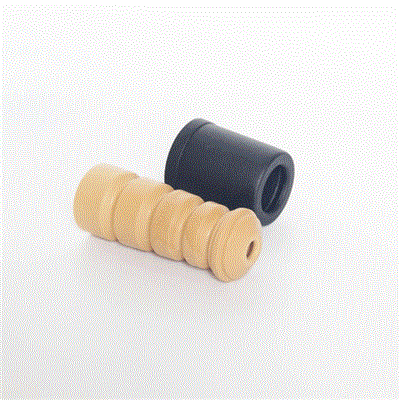
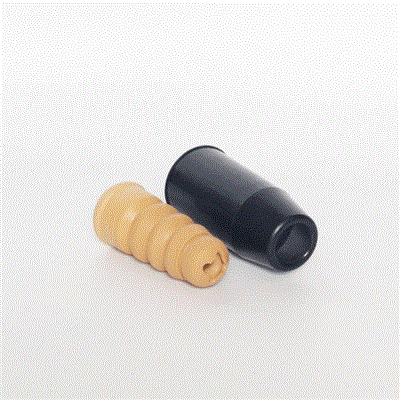
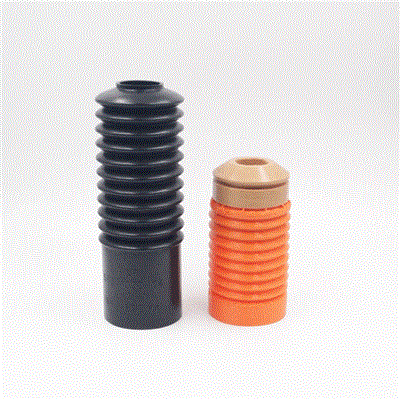
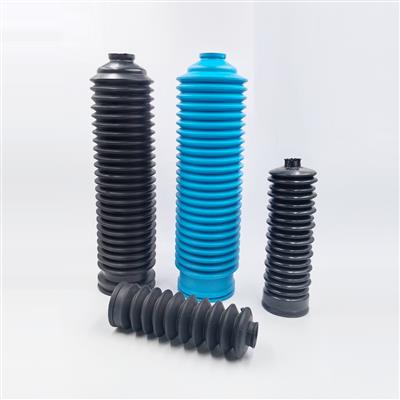
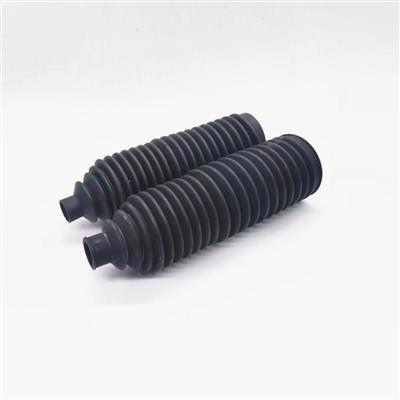
A dust cover, also called a shock dust boot, dust shield or strut bellows, is installed externally on the shock absorber piston rod, positioned above the oil seal. Its upper end mates with the piston rod and its lower end mates with the reservoir cylinder or connecting component. Compounds used in production include EPDM, nylon PA66, PU, NR, NBR and TPE, selected to suit the working temperature and the amount of flex the bellows has to survive.
Functions. It prevents external contaminants such as mud, dust and moisture from reaching the oil seal and the piston rod surface, which avoids scratching of the rod and damage to the seal. It also helps to block high temperatures and UV aging of the parts underneath it.
Service life. Design life of no less than 5 years or 80,000 km without cracking, hardening or deformation failure under conventional environmental conditions.
Quality standard. Manufactured to comply with IATF 16949 system requirements. Test items include hardness, tensile strength, ozone resistance and high and low temperature resistance from -40 C to +100 C.
Warranty. Warranty is provided with the complete shock absorber assembly. When the cover is sold separately, a 1 year or 50,000 km warranty is offered, covering material and manufacturing defects.
Customization. Moulds can be customized from customer supplied mounting dimensions, shape and colour, and different bellows profiles and material hardness adjustments are supported.
For a distributor, a workshop chain or an own brand programme, a dust cover is not a single part but a small family. The same damper platform can use two or three different cover profiles, and the covers cross over between model years in ways that are not always obvious from the vehicle list. The practical result is that a range is built from three inputs: the OE references to be covered, the dimensional groups into which those references collapse, and the duty level of the vehicles involved. Getting that structure right before the first order avoids carrying six part numbers where two would have covered the market, and it also avoids the opposite mistake of listing one number where the bead diameter differs between applications.
Covers that share an upper bead and a lower seat diameter can often share a part number even when they are listed against different vehicles. Grouping candidate OE references by bead diameter, lower seat diameter and free length usually reduces a long vehicle list to a short list of physical parts.
Service demand follows the vehicle parc and the road conditions in each market. A part fitted to a high volume platform in a market with rough roads will turn far faster than a part for a low volume imported model, and the two should not be stocked on the same policy.
| Range Tier | Typical Demand Pattern | Stock Policy |
|---|---|---|
| Core fast movers | Steady monthly demand | Hold stock, review every month |
| Standard coverage | Regular but uneven demand | Hold a minimum, top up by forecast |
| Slow movers | Occasional single unit demand | Back to back ordering against confirmed sales |
| New additions | Demand not yet proven | Trial quantity, then review after one season |
A cross reference is only useful if the dimensional data behind it has been checked. The reliable method is to confirm the bead diameter, the lower seat diameter, the free length and the rib count against the supplier drawing, and to treat a reference that has been carried over from another catalogue without measurement as unverified. Where a supplier publishes only a vehicle list, ask for the dimensional table behind the listing.
The dust cover range covers the main European and Asian platforms, and the references below are grouped as they are normally presented to trade buyers.
| Brand Group | Reference Examples |
|---|---|
| VW / Audi / Porsche | 357413175A, 1K0513425A, 8K0412137A, 4GD512137, 8W0412137, 4B0512137B, 4M0512137B, 8K0512137A, 95B412137, 99634350500, 99333310701, 99134350902, 98633350501, 971512137 |
| BMW / Mercedes-Benz / Land Rover | 33533411995, 31336776554, 31331096309, 33506864134, A2043230592, A2043260598, A2053230292, A1663230098, A1773235000, LR073344, LR024475, LR061354, T4N7367, T4N7368 |
| Toyota / Honda / Nissan | 51686-TG0-T01, 51686-SAA-E02, 51403-SNA-903, 51402-TR7-A01, 51688-SDA-A01, 52688-S0A-004, 51403-T2A-A01, 51686-TVA-A01, 51686-T7A-003, 52687-S5A-014, 51403-STK-A01, 52687-SFE-003 |
| Ford / Mazda / Hyundai / Kia | GV9B-28-1A0, 6C11-3K036-AC, BCKE-34-015, 54625-2D000, 54625-08000, 54625-0Q000, 55370-1C000, 54628-38000, 55316-38600, 55325-2E00, 54625-2Z000, 55316-2G700, 54625-C9000, 55370-B3000, 54625-D3000 |
The same references are also reached through the material and fitment notes in the dust cover material and fitment guide, which is the page to send to a customer who is trying to identify a cover by measurement.
| Field | What to State |
|---|---|
| Part number and description | Own reference plus the OE references to be covered |
| Material and hardness | Compound family with a Shore A range and tolerance |
| Bead dimensions | Upper bead profile and groove engagement |
| Lower seat | Seat or lip diameter, or the collar style required |
| Free length and ribs | Free length, number of ribs and wall thickness at the fold |
| Vent | Vent hole size and position, or no vent |
| Colour and marking | Colour, plus any date code or part marking needed |
| Quantity and packing | Order quantity, packing method and labelling |
| Documents | Certificate of conformance, test report, first article report |
A sample should be checked for the dimensions that matter in service, not only for appearance. Measure the bead, the seat and the free length, check the hardness on a flat area, confirm that the vent is open if one is specified, and flex the bellows through its full stroke to see that the folds do not bind. Where the same part exists in more than one compound, ask for both so that the material can be judged against the duty.
A trial quantity should be large enough to cover the first service cycle and to reveal any dimensional drift between the sample and the production run. Fitting a few covers to vehicles in the workshop, then checking them again after a normal service interval, is more informative than any bench inspection and costs very little.
Minimum order quantities for a moulded cover are usually set by the process rather than by the material value. A tool that runs a full shot per cycle carries a higher minimum than a tool that produces many parts per shot, and for a new profile the minimum is normally higher than for an existing one because the run follows the tool setup. Lead time is driven by the same factors, with new tooling taking longer than a repeat order.
| Cost Element | Main Driver | How to Reduce It |
|---|---|---|
| Unit price | Volume, compound, process | Consolidate references, accept a standard compound |
| Tooling | New profile, cavity count | Use an existing tool where the geometry allows |
| Quality documentation | Test scope and frequency | Agree a periodic rather than a per batch scope |
| Packing and labelling | Private label and inner packing | Standard master carton with own label where possible |
| Freight | Volume, mode, incoterm | Consolidate shipments and review the incoterm |
| Term | Responsibility Split | When It Suits a Buyer |
|---|---|---|
| EXW | Buyer collects at the factory | Buyer has its own forwarder and consolidation |
| FOB | Supplier delivers to the port of loading | Most common for sea freight programmes |
| CIF | Supplier pays freight and insurance to the port of destination | Buyer wants a landed port figure without arranging freight |
| DAP | Supplier delivers to the named place | Buyer wants a door figure for a small consignment |
The cartons should be cube efficient, because a rubber boot that is packed loosely costs more to move than the part itself. Pallet height, carton count and the total volume per order are worth checking before the shipment is booked, and the incoterm should be written into the purchase order rather than agreed informally.
| Option | Contents | Notes |
|---|---|---|
| Bulk pack | Poly bag of loose parts in a master carton | Lowest cost, suits a warehouse that re packs |
| Retail pack | Single part with a printed header or bag | Needs artwork and a fixed pack quantity |
| Private label | Own brand on the bag, the carton and the label | Confirm artwork approval and lead time |
| Kitted pack | Cover with clips or bands in one bag | Suits workshops that replace fasteners with the cover |
Whatever the option, the label should carry the part number, the quantity, the batch code and the production date, so that a warranty claim can be traced to a batch.
For a first order, ask for a certificate of conformance, the dimensional results for the bead and the seat, the hardness reading and the material test results for tensile strength and elongation. For a cover that will be sold under the buyer brand, add an ozone test and a low temperature test result so that the marketing claim about service life can be supported. For an automotive programme, a first article inspection report and an inspection control plan are normally required before volume supply, and the production controls behind those documents are described in the dust cover manufacturing and quality guide.
Dust cover demand follows service activity, which in many markets rises before and after the winter season and again at the start of the inspection cycle. Building stock ahead of those peaks, rather than during them, shortens the period when a fast mover is out of stock.
Safety stock should cover the demand during the lead time plus a margin, and slow movers should not be stocked at all where a confirmed order can be placed on a short production run. For a workshop network, the practical split is to hold fast movers at the regional warehouse and the balance centrally.
| Duty Band | Replenishment Approach | Watch For |
|---|---|---|
| Passenger car, paved | Forecast based, monthly review | Slow drift in demand across model years |
| Light commercial | Forecast based, monthly review | Higher grit exposure shortening cover life |
| Heavy duty and off road | Minimum stock plus regular top up | Replacement intervals shorter than forecast |
| Own brand programme | Contract quantity with call off | Pack and label change lead time |
| Area | What to Confirm |
|---|---|
| Quality system | IATF 16949 certificate and the products it covers |
| Range fit | Existing tools that match the references on the list |
| Technical support | Ability to identify a cover from measurements |
| Customisation | New profiles from supplied dimensions or samples |
| Documentation | Test reports, certificate of conformance, first article report |
| Logistics | Lead time, carton data, incoterms offered |
| Packing | Retail, private label and kitted packing capability |
The same checklist applies to the surrounding items, and covers are often ordered alongside other shock absorber parts or as custom moulded parts for a new platform.
That depends on how many physical geometries the target vehicles use. Grouping the OE references by bead diameter, seat diameter and free length usually shows that a market can be covered with fewer numbers than the vehicle list suggests, and a trial order confirms the grouping before the range is fixed.
Only where the duty matches. A compound chosen on price alone can harden or crack before the intended service interval, and a warranty claim costs more than the difference in unit price. Matching the compound to the temperature and exposure of the application is the better commercial decision.
Not always. Many requests are met from an existing tool because the bead, seat and free length already match or are close enough to be quoted from the same mould. A new tool is normally needed only where the geometry or the venting differs from anything in the range.
The carton and label data against the purchase order, the part dimensions on a sample against the drawing, the hardness reading, the batch code and the documents. Fitting a few parts and checking them after a normal service interval is the final confirmation that the range is correct.
Bonpora Parts supplies dust covers and shock dust boots in EPDM, NBR, NR, PU, TPE and nylon PA66, with the compound, hardness range, bead and seat dimensions and vent details recorded for every part number, and with hardness, tensile, ozone and low temperature test results available on request. If you are building or extending a range, send the OE references and the vehicle list and our engineers will group them by geometry, recommend the smallest complete set of part numbers and quote from an existing tool wherever the dimensions allow. A trial order with a dimensional and hardness report keeps the first release decision straightforward. Start from the dust cover range, review the fitting procedure in the dust cover installation guide, read the selection criteria in the dust cover selection and replacement guide, or contact our team with your range plan and annual volume. Further references are listed on the products page.