sales@bonporaparts.com
0086-10-64988621
English
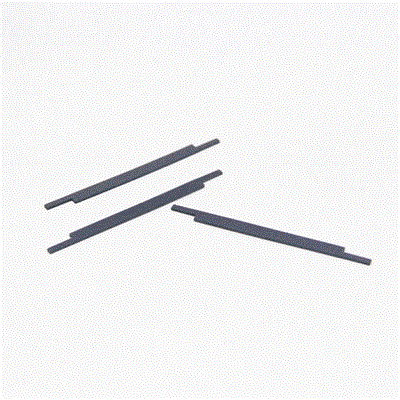
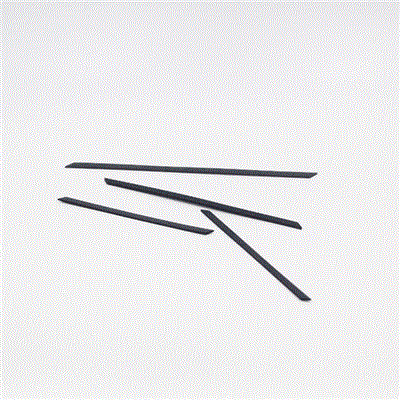
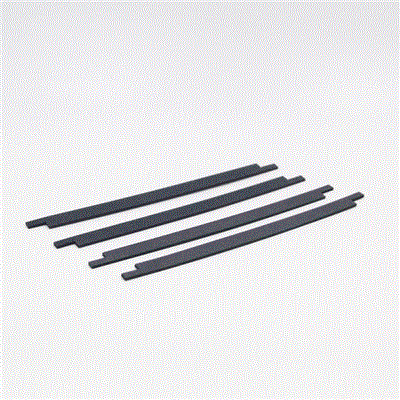
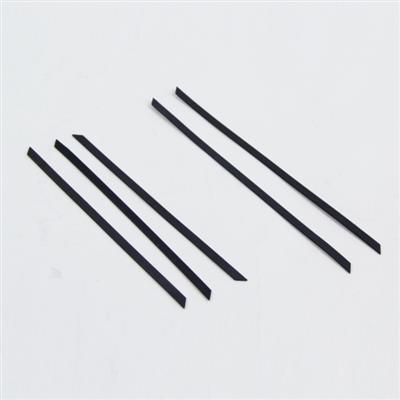
The source row describes a piston ring, also called a piston band, installed in the annular groove on the outer circumference of the shock absorber piston and reciprocating with the piston inside the working cylinder. Its main material is PTFE, and its function is to provide a seal between the piston and the cylinder, preventing excessive internal oil leakage during compression and rebound so that the damping force stays stable and repeatable. In some designs it also helps to control oil flow restriction.
That brief is demanding for a thin band. The ring has to seal against a bore it does not control, survive thousands of pressure cycles in hot oil and maintain its sealing ability even after wear, without compromising the basic performance of the damper. The design life quoted is no less than 80,000 km or 5 years, with a warranty of 1 year or 20,000 km. This article looks at how such a part is produced and controlled.
PTFE has excellent chemical resistance, a very low friction coefficient and a wide service temperature range, which is why it suits damper oil. Its weakness is creep under sustained load and relatively low wear resistance in abrasive conditions. Manufacturers therefore use filled compounds that keep the low friction behaviour while improving dimensional stability and wear.
| Compound type | Main benefit | Typical application note |
|---|---|---|
| Unfilled PTFE | Lowest friction, best chemical resistance | Light duty, clean oil circuits |
| Carbon filled | Improved wear resistance and load capacity | General damper use, higher pressure |
| Glass filled | Better dimensional stability, higher stiffness | Where bore fit must stay constant |
| Bronze filled | Good thermal conductivity and wear resistance | Higher duty and sustained heat |
| Graphite or carbon mix | Lower friction at high load | Performance and heavy duty dampers |
The source row notes that customisation is available for different diameters, thicknesses, gap configurations and materials, matched to piston dimensions. That means the compound should be agreed as part of the specification rather than assumed, because a change of filler changes friction against the bore, wear rate and the way the cut gap behaves under pressure.
A filler is only useful if it is evenly distributed. Poor dispersion shows up later as local wear and as friction values that vary around the circumference, which is exactly the variation a damper cannot tolerate. Compound quality therefore starts with the supplier of the compound itself, not with the molding press.
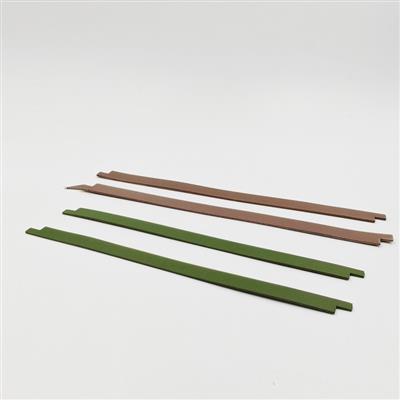
A piston band is not a closed ring. It is cut so that it can be expanded over the piston and so that it can compensate for bore variation and thermal growth in service. The source row lists both Z cut and V cut configurations, and gives the size reference in the form of length multiplied by width multiplied by thickness.
| Reference size (length x width x thickness, mm) |
|---|
| 178 x 5 x 1.0 |
| 163.5 x 7 x 1 |
| 162 x 10 x 1.5 |
| 162 x 8 x 1.5 |
| 149 x 10 x 1.5 |
| 149 x 8 x 1.5 |
| 149 x 4 x 1.5 |
| 137 x 4 x 1.5 |
| 130.5 x 8 x 1.5 |
The cut allows the band to be fitted without stretching it permanently and lets the ring press outward against the bore. A Z shaped or V shaped cut interlocks the two ends so that the joint does not form a straight leak path through the seal. The cut angle and the cut clearance are therefore functional dimensions, not cosmetic ones, and they are set by the mold or the cutting process rather than by hand fitting.
Gap is measured across the cut with the band held at its working diameter. Too large and oil bypasses the seal; too small and the ends butt together, which raises friction and can cause local overheating. Because the correct value depends on the piston diameter and the bore, it should be specified with the ring rather than adjusted at assembly.
PTFE compounds are normally compression molded into a cylindrical blank or a tube, then sintered. Sintering time and temperature control the crystallinity of the material, which in turn influences stiffness and creep resistance. Under-sintered material is softer and creeps more; over-sintered material can become brittle.
Thin bands are produced by skiving the sintered tube into a continuous strip of the required thickness. The skiving setup decides thickness tolerance and surface finish, and a blade that has begun to wear produces a thickness variation along the strip that is invisible on a single ring but measurable across a batch.
The strip is cut to length and the ends are formed into the Z or V geometry. Burrs at the cut ends are a particular risk, because they scrape the cylinder bore on the first strokes and can damage the piston groove. A deburring step with a controlled process is therefore part of production, not a finishing touch.
| Production step | Control point | Verification |
|---|---|---|
| Compound receipt | Filler type and dispersion, lot certificate | Incoming record and sample test |
| Preform and molding | Weight, pressure, dwell time | Process card per batch |
| Sintering | Time and temperature profile | Oven chart |
| Skiving | Thickness and surface finish | Micrometer across the strip |
| Cutting | Cut angle, gap, no burrs | Gauge check and visual on samples |
| Final inspection | Dimensions, gap, flatness, appearance | Release record per batch |
A batch release does not need a laboratory, but it does need consistency. The values below cover the features that actually influence sealing performance.
Flatness deserves a specific mention. A band that is twisted or bowed will not seat in its groove evenly, so it seals well in one area and leaks in another. The symptom on the vehicle is inconsistent damping rather than a straightforward leak, which makes the fault difficult to diagnose after the event.
Manufacturing control continues into assembly. The ring is expanded only as far as necessary, seated in the groove so that it is not twisted, and checked for free movement in the groove as the design intends. Sharp edges on the piston groove shoulder can cut the band during fitting, so the groove should be inspected before the ring is installed.
Because PTFE has a low friction surface, a band that has been fitted incorrectly can appear to sit correctly and only show the problem at the first pressure cycle. Checking that the cut is positioned as the drawing specifies, and that the band rotates freely in the groove, closes that risk at the bench.
The source row states a design life of no less than 80,000 km or 5 years, and notes that even after wear the ring maintains effective sealing without compromising basic performance. That reflects the way the part works: sealing is achieved by the band pressing against the bore with the support of internal pressure, so a modest amount of wear does not immediately cause a failure.
The warranty offered is 1 year or 20,000 km, which is shorter than the design life and covers material and manufacturing defects. In a rebuild the ring is normally replaced whenever the damper is opened, because the cost of the part is small compared with the cost of reopening the unit if sealing is lost.
| Condition found | Interpretation | Action |
|---|---|---|
| Even, light wear on the outer face | Normal service wear | Replace during the rebuild |
| Groove or step worn in one area only | Bore ovality, piston misalignment or a twisted band | Replace and check the piston and bore |
| Cut ends butted together | Gap too small or thermal growth | Replace with the correct gap |
| Cut ends with a large gap and oil bypass | Wrong gap or wear | Replace with the specified size |
| Brittle or cracked band | Ageing, overheating or oil incompatibility | Replace and review the oil and duty |
| Burr damage inside the groove | Fitting damage | Repair the groove, fit a new band |
Both interlock the two ends so that the joint does not form a straight leak path. The choice depends on the piston groove, the fit method and the pressure direction, and the source row lists both as available cut configurations for the standard size range.
The PTFE base is chemically very resistant, which is one reason it is used here. Filled compounds are also normally compatible, but where a damper uses a special fluid the compound and the oil should be confirmed together rather than assumed.
Because it decides whether the ring can compensate for bore variation and thermal growth. Too small and the ends butt, adding friction and heat; too large and oil bypasses the seal, which reduces and destabilises the damping force.
It is not recommended. The band has already been bedded to the bore it ran in, and the cost of the part is small compared with the labour of reopening the damper if the seal is lost.
Bonpora Parts and Components produces PTFE piston rings and piston bands for shock absorbers, with Z cut and V cut configurations, and custom diameters, thicknesses, gap configurations and materials matched to piston dimensions from drawing or sample. Review the piston ring range, read the piston ring selection guide, the failure analysis article and the installation guide, or compare the shock absorber component range and the piston rod range. Send your piston dimensions and required gap through the contact page for a matched quotation.