sales@bonporaparts.com
0086-10-64988621
English
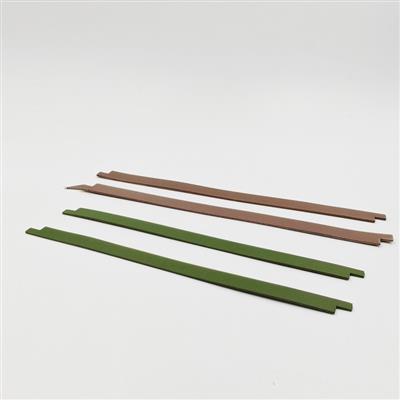
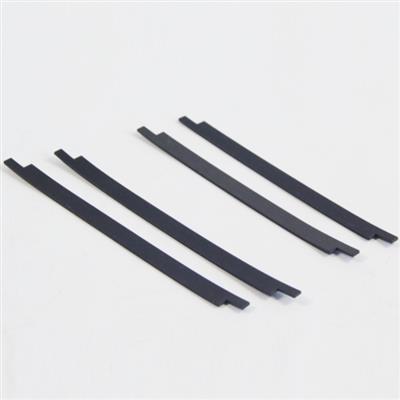
A piston ring, also named a piston band, is installed in the annular groove on the outer circumference of the shock absorber piston and reciprocates with the piston inside the shock absorber working cylinder. The main material is PTFE, or polytetrafluoroethylene.
The ring provides a seal between the piston and the working cylinder and prevents excessive internal leakage of oil during the compression and rebound strokes. Holding that leakage within a narrow band is what makes the damping force stable and repeatable from one damper to the next. In some designs the ring also takes part in controlling oil flow restriction, which is one of the ways a damper engineer shapes the force curve.
The ring sits in a machined groove and is loaded outwards against the cylinder wall by the pressure of the oil behind it and by its own elasticity. Because it travels the full stroke at every wheel movement, a typical damper ring completes several million cycles within its service life. That duty is the reason the material choice and the joint design matter far more than the apparent simplicity of the part suggests.
Two dampers built from the same components can still feel different if their rings seal differently. A ring that leaks slightly more than intended reduces the resistance at low piston speed, and the driver experiences that as a soft or vague first movement. Buyers who assemble dampers in volume therefore treat the ring as a controlled item rather than as a consumable, and they specify it with the piston rather than separately.
Bonpora lists PTFE as the main material for the piston ring. In industry practice PTFE is usually supplied either unfilled or with a filler that raises one particular property, and the choice is normally made together with the piston supplier.
| Compound | Where it is normally chosen | Practical notes |
|---|---|---|
| Unfilled PTFE | Standard dampers, moderate temperatures, general road use | Lowest friction, good chemical stability in damper oil, softer than filled grades |
| Carbon or graphite filled PTFE | Higher side loads, extended service intervals | Improved wear resistance and better dimensional stability under load |
| Glass filled PTFE | Applications where stiffness matters more than friction | Stiffer and more creep resistant, slightly more abrasive against some bore finishes |
| Bronze filled PTFE | Heavy duty and off highway use | Good thermal conductivity, which helps carry heat away from the contact band |
| Other polymers in specific designs | Where the damper manufacturer specifies an alternative | Always match the released specification rather than substituting by appearance |
PTFE combines a low coefficient of friction with resistance to the oils and additives found in damper fluid, and it keeps its properties across the temperature range a damper sees in service. Low friction protects the cylinder bore finish, which in turn protects the sealing performance of the ring across the whole stroke.
Filler content is the detail that quietly moves a price. A compound with a lower filler ratio can look identical on a photograph and wear differently after twenty thousand kilometres. When a quotation is noticeably lower than the rest, ask for the compound designation and the filler ratio in writing, and ask whether the supplier keeps the compound locked for repeat orders.
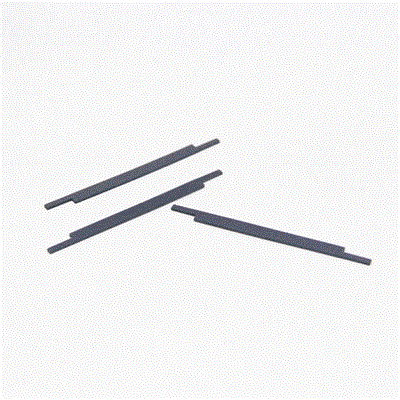
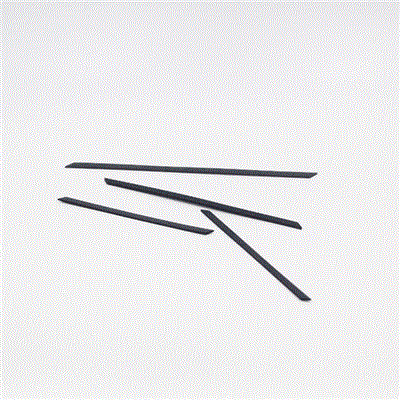
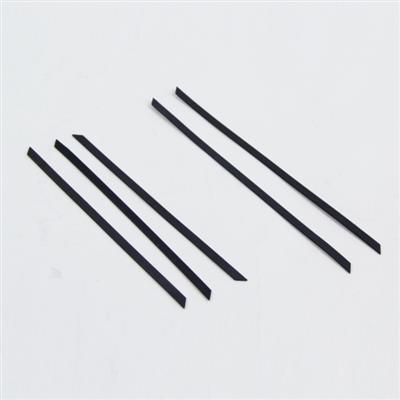
The ring is a cut strip, and the shape of the joint changes how it behaves once it is in the groove.
| Joint | Geometry | Behaviour and typical use |
|---|---|---|
| Z cut | Stepped joint with offset faces | The step closes the direct leak path, so the joint resists blow by better under pressure |
| V cut | Angled or chevron joint | Simpler to produce and to fit, with a controlled leak path that suits many standard dampers |
The joint type is normally fixed by the damper design, the groove width and the target leakage. It is not a free upgrade: a Z cut ring fitted where a V cut was released changes the leakage characteristic of the damper, and that shows up as a force curve outside the tolerance the customer approved.
Bonpora states that even after wear the ring maintains effective sealing without compromising the basic performance of the shock absorber. Both joint forms rely on the groove and on oil pressure to hold the band against the bore, so the sealing duty is shared rather than carried by the joint faces alone.
Bonpora lists the piston ring size as Length x Width x Thickness in millimetres. The table below reproduces the released size list for Z cut and V cut rings.
| Length (mm) | Width (mm) | Thickness (mm) |
|---|---|---|
| 178 | 5 | 1.0 |
| 163.5 | 7 | 1.0 |
| 162 | 10 | 1.5 |
| 162 | 8 | 1.5 |
| 149 | 8 | 1.5 |
| 149 | 4 | 1.5 |
| 149 | 10 | 1.5 |
| 137 | 4 | 1.5 |
| 130.5 | 8 | 1.5 |
The width and the thickness are read directly from the piston groove, because the strip has to fill it without standing proud. The length needs one clarification: confirm with the factory whether the listed figure is the developed length of the strip before bending or the length measured around the fitted ring, since the two differ by the joint allowance. Send the piston outside diameter, the groove width and depth, and the cylinder bore, and the supplier can confirm the matching reference from the released list.
Flatten the removed ring on a clean surface, then measure the developed length with a flexible tape, the width at three points with a vernier, and the wall thickness with a micrometer. Photo the ring beside the rule so the numbers are traceable. A ring that measures short against its nominal length has worn at the bore face, and a ring that measures thin has lost wall thickness, which is the change that reduces the sealing force.
PTFE is a soft polymer, so under sustained pressure it can deform slowly into the available space. That behaviour, usually called cold flow or creep, is controlled by the groove dimensions, by the filler in the compound, and by the way the ring is supported by the piston land behind it. A groove that is too deep gives the material somewhere to go and the seal weakens over time.
When a damper is stripped for any reason, the ring should be read before it is discarded. A polished band that still shows its full width, square edges and no step at the joint is a ring that has worn evenly. A tapered cross section, a shiny patch on one side only, or a joint that no longer closes points to a misalignment, a distorted bore or a groove that was machined outside tolerance.
Bonpora lists a design life of no less than 80,000 km or 5 years for the piston ring, and separately offers a 1 year or 20,000 km warranty. The two numbers answer different questions, and mixing them up creates disputes at the counter.
| Figure | Value listed by Bonpora | What it describes |
|---|---|---|
| Design life | Not less than 80,000 km or 5 years | Expected useful service of the part in a correctly built damper |
| Warranty | 1 year or 20,000 km | The period covered for a verified manufacturing defect |
Design life is a planning figure based on normal operating conditions, oil compatibility and correct assembly. Warranty is a commercial term for defects. A ring that reaches 60,000 km in a vehicle driven on rough roads has not necessarily failed against its warranty, and a ring that fails within the first few thousand kilometres usually points to an assembly or bore problem that the strip down can identify.
| Observation | Likely cause | Action |
|---|---|---|
| Uneven shiny band, one side worn more | Piston running off centre, bent rod or worn guide | Check rod straightness and bore roundness before refitting a new ring |
| Joint faces polished and gapped | Ring installed with a joint gap outside the released setting | Re-measure the ring and confirm the joint setting with the supplier |
| Soft, frayed or swollen material | Fluid contamination or a compound outside the released specification | Check the oil batch and the compound designation on the delivery note |
| Thickness reduced against nominal | Normal or accelerated wear at the bore face | Replace the ring and inspect the bore finish for scoring |
| Cracked ring with clean break | Ring fitted over a sharp groove edge or stretched during assembly | Deburr the groove, warm the ring before fitting, replace the part |
Internal leakage rarely produces a dramatic failure. It appears as a damper that feels weaker at low piston speed, a force curve that drifts during a dyno run, or a pair of dampers on the same axle that no longer feel matched. Because the ring is hidden, the first evidence is usually a dyno trace rather than a visual inspection.
Bonpora supports customization of different diameters, thicknesses, gap configurations and materials based on customer drawings or samples, with matching design according to piston dimensions. A complete enquiry therefore carries more than a size: it carries the piston drawing, the groove width and depth, the cylinder bore, the joint type, the compound requirement, the annual quantity and the packing format.
Two practical details decide whether a repeat order goes smoothly: whether the compound is locked for the life of the project, and whether the cut geometry is controlled by a dedicated fixture or by hand finishing. Both are worth asking about before tooling is committed.
Yes. Piston ring and piston band are two names for the same component in a shock absorber, a cut strip of PTFE based material fitted in the annular groove of the piston. Whichever name a catalogue uses, the functional description, the groove fit and the size list are the same.
Read the width and thickness from the piston groove, then confirm the length basis with the factory, since the listed length may be the developed strip length rather than the fitted circumference. Sending the piston diameter, groove dimensions and bore together with the enquiry avoids an incorrect match.
The Z cut uses a stepped joint that closes the direct leak path and resists blow by better under pressure. The V cut uses an angled or chevron joint that is simpler to produce and gives a controlled leak path. The correct choice is the one released for the damper design, not the one that looks stronger.
It can be replaced as a part, but it should not be replaced in isolation from the inspection. Wall thickness loss, a misaligned piston and a scored bore all destroy a new ring quickly, so the rod, the bore and the groove deserve a check whenever a ring is renewed.
Bonpora produces piston rings under the IATF 16949 system and offers customization of diameters, thicknesses, gap configurations and materials from samples or drawings. Send the measured piston and groove data, the cylinder bore, the required joint type and the annual volume, and the factory will confirm whether a released size fits or quote a matched ring. Start from the piston ring range, review the damper parts around it in the shock absorber parts range, see how the ring sits inside the chassis and suspension assembly, and send drawing data through the contact page.