sales@bonporaparts.com
0086-10-64988621
English
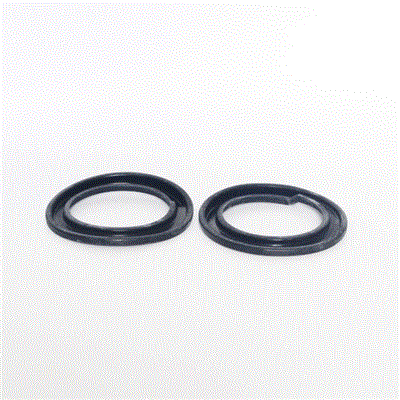
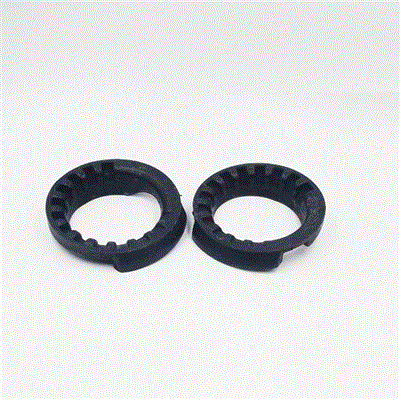
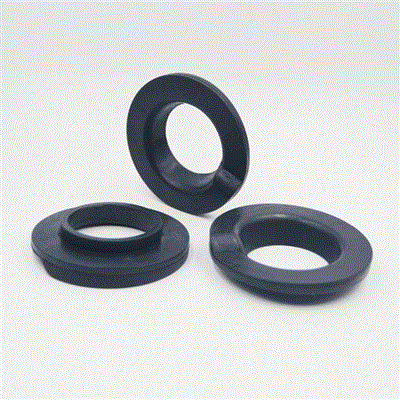
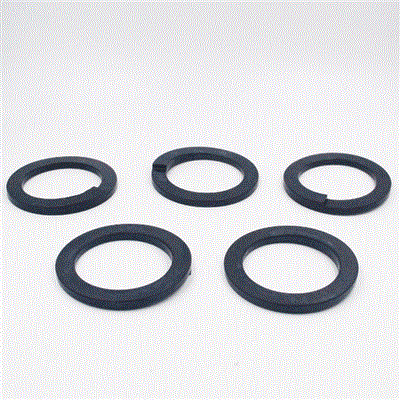
A spring seat, also called a spring isolator or spring spacer, is located on the exterior of the shock absorber body or at the upper end of the piston rod. It positions and supports the suspension coil spring, normally in contact with the lower or the upper end of the spring inside the shock absorber assembly. It is made from NR, NBR, EPDM, PU, HDPE or TPE, with or without metal bonded to it.
The part carries the full spring load for the life of the assembly, so its performance depends on how the material is compounded, how the metal insert is prepared and how the cure cycle is controlled. This guide describes what a buyer should expect to see controlled during manufacture and which documents to request with each batch.
The drawing is the only document that ties the tool, the compound and the inspection plan together. The dimensions are the straightforward part. The features that decide whether the seat survives its design life are usually the ones that are easy to leave out.
| Drawing Item | Why Production Needs It |
|---|---|
| Inner and outer seat diameter with tolerances | Centres the spring end and controls lateral location |
| Height and location step | Sets the installed spring length and therefore ride height |
| Spring end form | Determines the shape of the location feature |
| Mounting hole positions and diameters | Defines the drilling or moulding jig |
| Material and Shore A range | Selects the compound family and the cure system |
| Metal insert material, thickness and coating | Sets the bonding route and the corrosion specification |
| Bond strength requirement | Names the peel or push out value and the test method |
| Design load and permitted compression set | Gives the test house a pass and fail reference |
| Marking and traceability | Defines the part number and batch code to be applied |
Where the drawing is silent on the spring end form or the permitted compression set, the supplier will still produce a part with the right outline, but it may not hold its height or keep the spring located, and the difference appears in service rather than on the inspecting bench.
Each material family brings its own process requirements, and a compound that is not controlled at the mixing stage cannot be corrected later in the press.
| Material | Process Note | Typical Control |
|---|---|---|
| Natural rubber (NR) | Needs an antiozonant and antioxidant package | Hardness, tensile and ageing check per compound lot |
| Nitrile (NBR) | Oil resistance depends on the acrylonitrile content | Immersion swell test on the compound |
| EPDM | Excellent weathering and water resistance | Ozone test and hardness check |
| Polyurethane (PU) | Moisture sensitive during processing and storage | Moisture control on the granulate and a hardness check |
| HDPE | Dimensional stability depends on the moulding conditions | Shrinkage and dimension check |
| TPE | Hard and soft zones must meet consistently | Section check at the zone boundary |
Compound traceability matters for a safety related position. A batch code that reaches back to a compound lot is what allows a field failure to be compared against the specification rather than simply replaced.
Where a metal insert is bonded into the seat, the bond is created during vulcanising from a primer and an adhesive applied to prepared metal. Four variables have to be controlled together.
For plastic seats in HDPE or TPE the insert is normally moulded in or assembled with a mechanical interlock rather than bonded, and the relevant control is the fit and the retention force rather than bond strength.
Compression moulding remains suitable for short runs and large seats, while transfer and injection moulding give better consistency at higher volumes. The controls that matter to the buyer are the same whichever route is used.
| Control | What Goes Wrong Without It |
|---|---|
| Preform weight controlled per cavity | Under packing, porosity or excessive flash |
| Insert loaded square in the mould | Uneven section on one side and a tilted seat |
| Cure temperature and time recorded per cycle | Batch to batch variation in hardness and stiffness |
| Deflashing without cutting the elastomer | Nicks that become crack starters in service |
| Batch code applied before packing | Mixed batches that cannot be traced back |
Where the mounting holes are formed after moulding rather than in the tool, the drilling jig and the trimming operation become part of the quality plan.
| Characteristic | Method | Sampling Basis |
|---|---|---|
| Seat inner and outer diameter | Gauge or calliper | Per batch, and per cavity at first article |
| Height and step depth | Height gauge | Per batch |
| Hole position and diameter | Jig check or gauge | Per batch |
| Concentricity of the seat to the insert | Dial indicator on a fixture | First article and periodic |
| Elastomer hardness | Shore A durometer at three points | Per batch |
| Mass | Balance | Per batch, as a quick compound check |
| Coating thickness and adhesion | Gauge and cross hatch or bend test | Per coating lot |
| Test | What It Demonstrates |
|---|---|
| Load deflection at the design load | That the seat holds its height under the spring load |
| Compression set after a defined time at load | That the ride height will remain stable in service |
| Peel or push out test on the bonded insert | Adhesive strength and consistent metal preparation |
| Repeated load cycling | Fatigue life under the normal spring load |
| Heat ageing with property recheck | Stability of hardness and load deflection over time |
| Ozone or weathering exposure | Surface cracking resistance on exterior positions |
| Salt spray on the insert and coating | Corrosion performance in a wet or salted environment |
| Low temperature behaviour | Suitability for cold climate markets |
A dimensional report confirms that the part resembles the drawing. A hardness, load deflection and compression set report confirms that it will keep the ride height. A bond result confirms that the insert will stay in place. For a seat under continuous spring load, all three groups are worth requesting.
Quality management to IATF 16949 supports this route by requiring that dimensional tolerances, weld strength where applicable and coating adhesion are controlled and recorded rather than checked informally.
Elastomer parts continue to age in storage, and a seat kept in sunlight, in ozone rich air or near an electric motor will degrade before it is fitted. Cartons should be closed and labelled with the part number, the batch code and the production date. Recommended storage is a cool, dry, dark place away from oils, solvents and ozone sources, with stock rotated on a production date basis. Parts with a bonded insert should be packed so that the insert edge cannot cut into the elastomer of the part next to it.
| Area | What to Ask For |
|---|---|
| Quality system | Certification such as IATF 16949 or ISO 9001, with scope and validity date |
| Compound control | Named grade, hardness range and available special formulations |
| Bonding or insert process | The preparation sequence and the adhesive or interlock design, in writing |
| Testing capability | Load deflection, compression set and bond testing in house, and what is sent out |
| Batch documents | Dimensional report, hardness result, load deflection result and certificate of conformance |
| Traceability | Batch code structure and retained sample policy |
| Tooling | Which diameters, heights and hole patterns already exist, and the lead time for a new tool |
| Change control | How a change of compound, tool or process is notified and requalified |
These points are worth confirming before a first order rather than after, because a seat that is correct on the drawing and wrong in the compound or the bond is difficult to detect at goods receiving. Customisation of diameters, heights and mounting hole positions is quoted from drawings or samples under custom moulded and bonded parts.
Because the installed behaviour depends on the compound, the hardness and the insert design rather than on the outline alone. Two seats can share the diameter, the height and the hole pattern while using different materials or a different insert, and the difference shows up as ride height variation, noise or early compression set rather than as a visible defect.
The bond quality and the surface preparation, because a bonded insert carries the location function as well as part of the load. A peel or push out result for the production batch is the practical evidence, together with a visual check that no adhesion failure has started at the edge of the insert.
Yes. A seat that takes a compression set allows the spring to sit lower, so the ride height changes even though nothing has broken. Requesting a compression set value at the design load is the way to confirm that the part will hold its height rather than simply surviving the load.
For a safety related suspension position, yes. A change of mould, press or preparation line can alter the cure profile and the bond quality without any change to the drawing, so a first article with dimensions, hardness, load deflection and bond results should be approved before full production resumes.
Bonpora Parts manufactures spring seats, spring isolators and spring spacers in NR, NBR, EPDM, PU, HDPE and TPE, with or without a bonded metal insert, moulded to the diameter, height, spring end location and mounting hole positions shown on your drawing. Incoming compound and insert controls, recorded vulcanising cycles, hardness and load deflection verification, compression set and bond testing and batch traceability are part of the standard route. Start with the spring seat range, read the fitting sequence on the spring seat installation guide, review the wider chassis and suspension programme, or contact our team with your specification and annual volume. Related shock absorber parts are supplied on the same route, and further references are listed on the products page.