sales@bonporaparts.com
0086-10-64988621
English
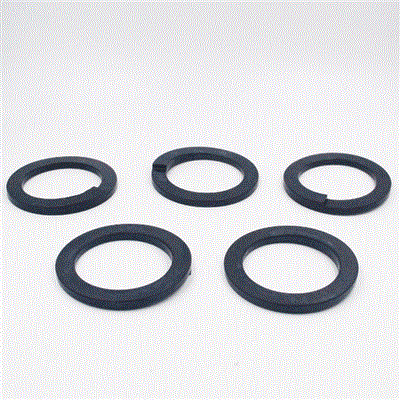
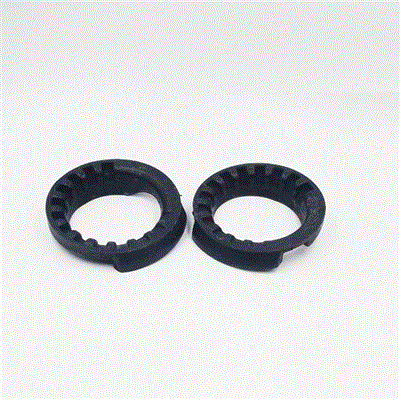
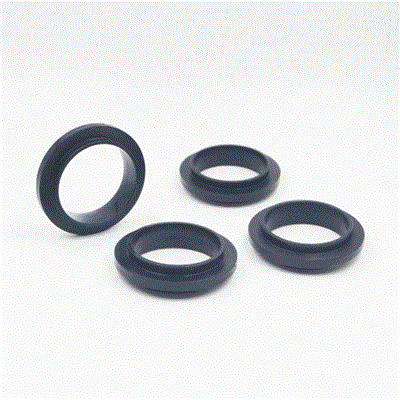
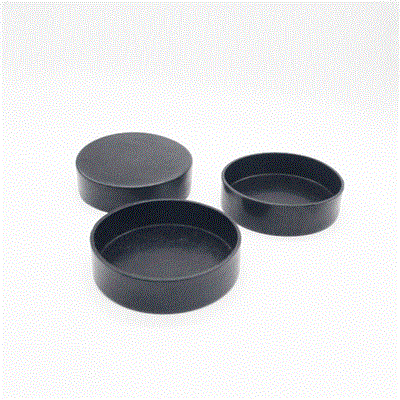
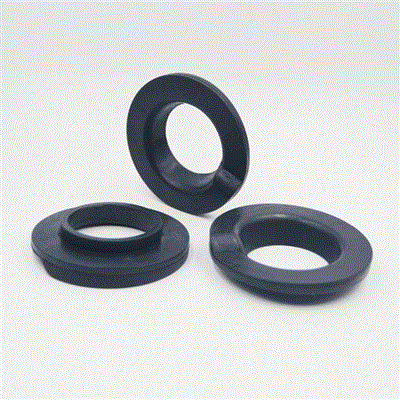
A spring seat, also called a spring isolator or a spring spacer, is located on the exterior of the shock absorber body or at the upper end of the piston rod. It positions and supports the suspension coil spring and normally sits in contact with the lower or the upper end of the spring inside the shock absorber assembly. It can be made from NR, NBR, EPDM, PU, HDPE or TPE, with or without metal bonded to it.
Its two duties pull in different directions. The seat withstands the vertical load transmitted by the spring and transfers that load evenly into the shock absorber body or the vehicle body, and it limits lateral displacement of the spring so the coil cannot interfere with the surrounding components. A compound chosen only for load capacity tends to be hard and transmits noise; a compound chosen only for noise isolation tends to creep under sustained load. Material selection is the search for the balance that suits the application.
The six families above cover the range. Three of them, NR, NBR and EPDM, are conventional elastomers with high elasticity. Polyurethane, or PU, sits between elastomers and plastics, with high load capacity and good abrasion resistance. HDPE and TPE are thermoplastic based options that offer tighter dimensional control and process as moulded or machined parts rather than as vulcanised rubber.
Bonpora lists a service life of no less than 80,000 km or 2 years for a spring seat, with a warranty of 1 to 2 years or 80,000 km depending on the reference. For a compound to reach that life it has to hold its thickness under a continuous load, resist the ozone and ultraviolet exposure of an underbody environment, and stay compatible with whatever oil, brake fluid or road salt reaches it.
| Compound | General character | Behaviour to expect in service | Where it is normally chosen |
|---|---|---|---|
| NR, natural rubber | High elasticity and high strength for a low cost | Excellent for load and noise; limited resistance to oil and to ozone unless protected | General road applications with no oil exposure |
| NBR, nitrile rubber | Good resistance to oils and fuels | Keeps its shape around oil contamination; moderate ozone resistance | Assemblies close to oil or hydraulic sources |
| EPDM | Very good ozone, weather and water resistance | Stable in road salt and sunlight; lower oil resistance than NBR | Exposed underbody positions and long service life |
| PU, polyurethane | High load capacity with good abrasion resistance | Carries heavy spring loads in a thin section; harder grades transfer more noise | Heavy duty, commercial and performance applications |
| HDPE | Stiff, low friction, dimensionally stable | Holds a precise step and slides against the spring end; minimal damping | Where location and low friction matter more than isolation |
| TPE | Thermoplastic elastomer with an adjustable hardness range | Processes like a plastic, behaves like a flexible part; consistent dimensions | Volume production where tight tolerance and clean appearance are wanted |
Hardness is quoted on the Shore A scale for elastomers and is meaningful only as a range with a tolerance. Two suppliers can quote the same nominal hardness and still deliver different load deflection behaviour, because the filler system and the cure differ. Ask for the load deflection value at the design load and for the compression set limit, both of which describe behaviour rather than appearance.
Underbody temperatures are moderate in normal use but can rise sharply close to a damper that is working hard. Oil, brake fluid and hydraulic fluid are the contaminants that appear most often in failed seats, and each attacks elastomers differently. Where a seat is being specified for a vehicle known for fluid leaks in the area, an oil resistant compound removes a failure mode before it appears.
Many spring seats are supplied with metal bonded to the elastomer, and the phrase with or without metal bonded in the part description is a design decision rather than a purchasing preference.
The insert carries the fixing duty, provides a rigid mounting face against the body or the damper, and prevents the elastomer from being squeezed out of position under sustained load. In many designs the bonded plate also sets the hole pattern or the mounting geometry that locates the seat.
A bonded joint relies on an adhesive system applied to a prepared metal surface. A mechanically retained insert relies on a flange, a groove or a formed edge that traps the elastomer. Bonding gives a continuous interface and a cleaner load path; mechanical retention tolerates more movement but allows slight relative displacement, which can develop into a wear point.
Bond failure usually starts at an edge, where water, salt or oil can reach the interface and where the stress concentration is highest. It shows as a gap or a rust line, and it is progressive. For a service part, the practical implication is that any visible separation at the bond edge is a reason to reject the seat, because the joint will not recover once the interface has opened.
The step keeps the spring end in place. Its depth and diameter have to suit the spring end form, which may be a flat ground end, an open end or a pigtail. A step that is too shallow allows the spring to walk under lateral load; a step that is too deep can trap water and abrasive grit against the seat face.
Thickness at the contact face sets both the load capacity and the isolation. A thick elastomer section carries load with more deflection, which reduces noise but increases the risk of compression set. A thin section is stiffer and holds its geometry better. Polyurethane and the thermoplastic options allow a thinner section for the same load, which is why they appear in heavy duty applications.
Where a metal plate is bonded, the elastomer should be shaped so that load passes through a section designed for it rather than through an edge. Sharp transitions between the bonded face and the loaded face concentrate stress and become the origin of both cracking and bond separation.
| Application condition | Direction that usually fits | Reason |
|---|---|---|
| Standard road car, no fluid exposure | NR or EPDM elastomer | Good isolation and load capacity at moderate cost |
| Exposed underbody, road salt, long intervals | EPDM, with a protective compound | Weather and ozone resistance suit an exposed position |
| Oil or hydraulic fluid nearby | NBR based compound | Resists swelling and softening from oil contact |
| Heavy duty or commercial use, high load | PU, in a grade matched to the load | Carries high load in a compact section with good abrasion resistance |
| Precise location step with minimal friction | HDPE or a hard TPE | Dimensional stability and low friction against the spring end |
| High volume with tight tolerance | TPE or a moulded part to drawing | Consistent dimensions and a repeatable step |
Bonpora supports customization of different diameters, heights and mounting hole positions based on drawings or samples, which means the compound and the geometry are normally settled together. Sending the spring end form, the load, the temperature environment and any fluid exposure in one enquiry avoids a round of samples that cannot pass validation.
Spring seats from Bonpora are produced under the IATF 16949 system, with dimensional tolerances, weld strength and coating adhesion controlled. On a receiving inspection, four checks catch the majority of problems.
Keep a set of first article records for each reference. When a complaint arrives later, those records are what allow the supplier to confirm whether the delivered part matches what was approved.
Neither is better in general. Rubber compounds give more isolation for a given load and suit standard road use. Polyurethane carries higher loads in a smaller section with better abrasion resistance, which suits heavy duty and performance applications. The correct answer depends on load, available space and the noise target.
Only if the original design has one, or if the seat has to carry a fixing load and hold a rigid mounting face. Substituting a plain elastomer seat for a metal bonded seat changes the position of the spring and the load path into the body, so the construction of the removed part should be matched.
Bonpora lists a service life of no less than 80,000 km or 2 years for a spring seat, with a 1 to 2 year or 80,000 km warranty depending on the reference. Short life in practice usually traces back to heat, fluid contamination or an assembly error rather than to the compound family alone.
It can where the design intends a stiff locating seat rather than an isolating one, because HDPE holds a precise step and slides against the spring end. It is not a general substitute for an elastomer seat, since it offers little noise isolation and no compliance.
Bonpora produces spring seats in NR, NBR, EPDM, PU, HDPE and TPE, with or without metal bonded, and supports customization of different diameters, heights and mounting hole positions from samples or drawings. Start from the spring seat range, compare the specification detail in the spring seat selection guide, review how the parts are produced in the spring seat manufacturing guide, and send the spring data through the contact page.