sales@bonporaparts.com
0086-10-64988621
English
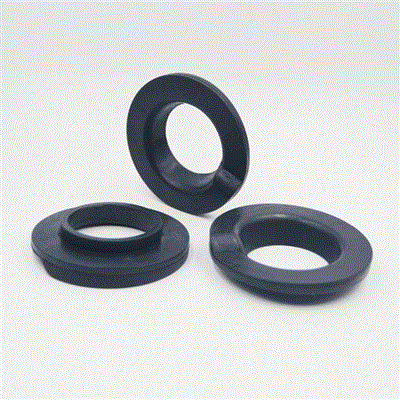
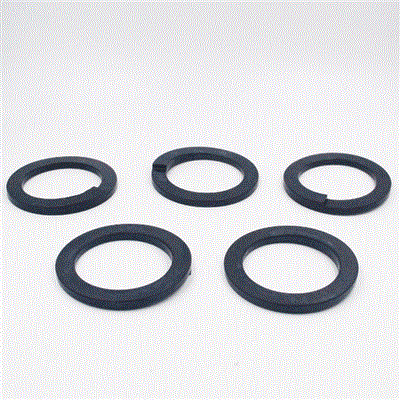
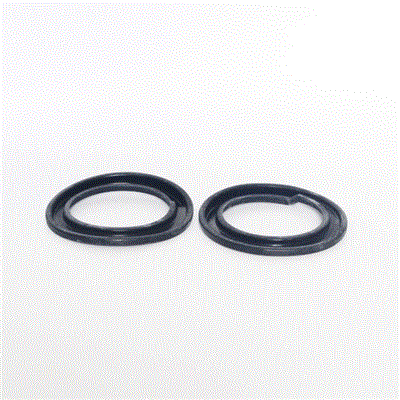
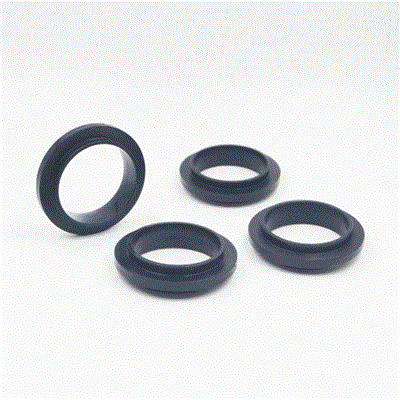
A spring seat, also called a spring isolator or spring spacer, is located on the exterior of the shock absorber body or at the upper end of the piston rod. It positions and supports the suspension coil spring, normally in contact with the lower or the upper end of the spring inside the shock absorber assembly. It is made from NR, NBR, EPDM, PU, HDPE or TPE, with or without metal bonded to it.
For a distributor, the difficulty is rarely finding a factory that can mould the part. It is covering real demand across many vehicle applications, quoting it on a comparable basis and keeping the compound and the dimensions consistent order after order. This guide covers the purchasing side of that work.
A spring seat is only ever sold as part of a job. Nobody replaces a seat on its own, because the strut has to be stripped to reach it. That single fact should shape the range plan: the part is offered as part of a strut or shock absorber kit rather than as an isolated reference.
| Grouping | Why It Helps the Counter |
|---|---|
| By vehicle application | The counter starts from the model, not from a diameter |
| By strut or shock absorber reference | The seat can be sold with the damper in one transaction |
| By position | Upper and lower seats are different parts and are often ordered together |
| By service kit | Seat plus bump stop, dust cover and top mount as one reference |
| By demand band | Fast movers held in depth, long tail held as a quoted special |
The practical starting point is the sales history from the damper and strut references already stocked. Ranking those references by movement and mapping each one back to its seat, bump stop and dust cover turns an existing catalogue into a service kit catalogue without needing new demand data.
| Field | What to Record |
|---|---|
| Internal reference | House number and supplier reference |
| OE and competitor numbers | All known references, including superseded numbers |
| Vehicle application | Make, model, platform, years and axle position |
| Position on the strut | Upper or lower, and whether a handed part is required |
| Dimensions | Seat diameter, height, step depth and hole pattern |
| Material | Compound family, hardness and whether an insert is bonded |
| Spring end form | Pigtail, flat ground or open end |
| Interchange status | Exact, functionally equivalent, or not interchangeable |
Two errors cost more than the rest on this part. Treating a seat with a different step depth as an exact interchange, because the diameter matches, and ignoring whether the original had a bonded metal insert. Both produce a part that fits and behaves differently, which is the hardest kind of complaint to resolve at the counter.
| Stage | What to Request | What It Settles |
|---|---|---|
| Sample for fit | One or two parts | Whether the dimensions suit the strut and the spring |
| First article | Dimensional report, hardness result and a photograph | Whether the tool matches the drawing |
| Performance sample | Load deflection and compression set results | Whether the seat will hold ride height |
| Trial order | A quantity sufficient for a workshop or fleet test | How the part performs in real service |
| Feedback review | Any failure or complaint data from the trial | Whether the compound or the step depth needs revision |
A trial is worthwhile even where the price is slightly higher, because a ride height complaint traced back to a seat is expensive to resolve once the parts are in the field. Any part that fails during the trial should be inspected and reported rather than quietly replaced.
| Cost Element | What to Clarify Before Ordering |
|---|---|
| Unit price | Whether it is fixed for a period or linked to a raw material index |
| MOQ per reference | Whether it applies per part number or per total order |
| Tooling | Whether a new mould is charged, who owns it and whether the charge is amortised against volume |
| Sample cost | Whether samples are free and whether freight is charged |
| Packing | Whether export cartons, pallets and labels are included |
| Freight and insurance | Incoterm, port of loading and transit time |
| Duty and clearance | Origin, tariff treatment and documentation |
| Payment terms | Deposit and balance, and the currency of the contract |
The landed cost is the number that belongs in a comparison rather than the ex works price. A supplier quoting a lower unit price with a new tool charge on every reference, or with packing and labelling excluded, can be the more expensive option over a year of purchases.
| Check | Method | Frequency |
|---|---|---|
| Carton and label against the order | Visual and document check | Every shipment |
| Part number and batch code on the part | Visual | Every shipment |
| Seat diameter, height and step depth | Gauge or calliper on a sample | Every shipment |
| Mounting hole position | Jig check on a sample | Every shipment |
| Elastomer hardness | Shore A durometer on a sample | Every shipment |
| Insert presence and bond | Visual, with the batch report on file | Per batch document |
| Coating condition | Visual, with a salt spray report on file | Per coating lot |
| Full dimensional and performance audit | Third party laboratory | Annually, or after a supplier change |
Third party inspection is most valuable immediately after a tool change, a compound change or a move to a different moulding line, because those are the events that alter a part without altering the drawing.
| Area | Question to Ask |
|---|---|
| Quality system | Which certification is held, with scope and validity date |
| Range fit | Which diameters, heights and hole patterns already exist in the tool library |
| Compound range | Whether NR, NBR, EPDM, PU, HDPE and TPE are all available and whether special formulations exist |
| Engineering support | Whether they will review a ride height or noise complaint and propose a change |
| Testing | What is tested in house and what is sent out |
| Documents | Whether a certificate of conformance, dimensional report and load deflection result come with each batch |
| Lead time | Standard production time and the buffer for a peak season |
| Change notification | How a change of compound, tool or process is communicated |
| Complaint handling | What evidence a claim requires and how long it stays open |
The declared service life for this family is normally no less than 80,000 km or two years, with a warranty period commonly stated as one to two years or 80,000 km. Agree in advance what evidence a claim requires, typically the part number, the batch code, the vehicle application, the mileage and a photograph of the failed part. Agree also whether the remedy is a replacement part, a credit or a joint investigation.
Where the same position has failed more than once on the same model, the useful response is a review of the specification rather than an automatic credit, which is why warranty records should reach the engineering contact instead of stopping at the accounts department.
As kits where possible. Because the strut has to be dismantled to reach the seat, the practical sale is seat plus bump stop plus dust cover, and often the top mount as well. A kit reference sells more parts per transaction and reduces the risk that a workshop has to stop work waiting for a small component.
Fix the specification first and then compare the landed cost. Two quotes for the same diameter and height can differ in material, hardness, step depth, insert design and hole tolerance, and those differences appear as ride height variation or noise rather than as a visible defect. Ask for load deflection and compression set values alongside the dimensional report.
Not always. Where the diameter, height and hole pattern already exist in the supplier tool library, only the compound or the marking may need to change. A new mould is normally required when the step depth, the hole pattern or the seat diameter differs from anything already tooled, and tooling ownership and amortisation should be agreed before the order is placed.
A packing list, a certificate of conformance and a batch level dimensional and hardness report as a minimum, with a load deflection result where the position is safety related or the part has failed before. The batch code on the carton should match the code on the parts, so a future complaint can be traced back to a mould, a press and a compound lot.
Bonpora Parts supplies spring seats, spring isolators and spring spacers in NR, NBR, EPDM, PU, HDPE and TPE, with or without a bonded metal insert, moulded to the diameter, height, spring end location and mounting hole positions shown on your drawing. Quality management to IATF 16949 controls dimensional tolerances, weld strength and coating adhesion, and a declared service life of no less than 80,000 km or two years is supported by a one to two year or 80,000 km warranty. Where an original reference is obsolete or a number is unreadable, send the dimensions, the spring end form and a photograph and our engineers will match the closest existing tool or quote a new one. Begin with the spring seat range, see how the parts are validated on the spring seat manufacturing guide, or contact our team with your specification, target price and annual volume. Related dust covers, bump stops and shock absorber parts can be supplied in the same programme, new dimensions are quoted under custom moulded and bonded parts, and further references are listed on the products page.