sales@bonporaparts.com
0086-10-64988621
English
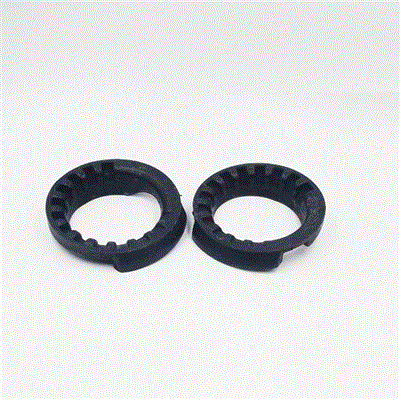
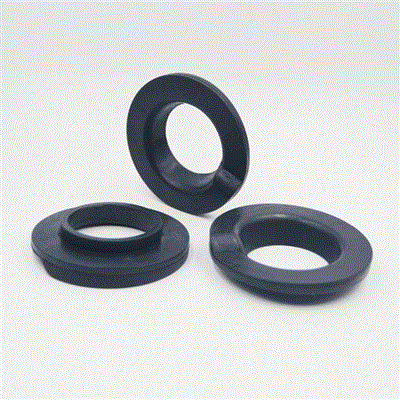
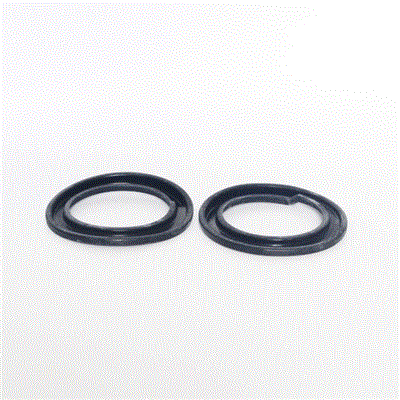
A spring seat, also called a spring isolator or spring spacer, is located on the exterior of the shock absorber body or at the upper end of the piston rod. It positions and supports the suspension coil spring, normally in contact with the lower or the upper end of the spring inside the shock absorber assembly. It is made from NR, NBR, EPDM, PU, HDPE or TPE, with or without metal bonded to it.
The part withstands the vertical load transmitted by the spring and transfers that load evenly into the shock absorber body or the vehicle body, while limiting lateral displacement of the spring and preventing interference between the spring and the surrounding components. This guide sets out how the part is specified, how the material is chosen and what a buyer should confirm before ordering.
A coil spring does not sit directly on bare metal. Both ends of the spring are separated from the strut or the arm by a seat, and the seat does three jobs at once. It gives the spring end a defined location so that the spring cannot creep round or shift sideways, it spreads the load from a small number of coil turns into the surrounding structure, and it breaks the metal to metal contact path that would otherwise transmit spring noise directly into the body.
Because the part sits inside the spring, its failure is rarely visible from outside the vehicle. The first sign is usually a noise, a change in ride height or a spring that has moved off its stop, which is why the seat is worth understanding before a complaint is diagnosed rather than after.
| Type | Position | Function |
|---|---|---|
| Upper spring seat | Top of the spring, under the upper mount | Locates the spring end and isolates the top of the spring |
| Lower spring seat | On the shock absorber body or the arm | Supports the spring end and spreads load into the strut body |
| Spring isolator | Between the spring end and the seat | Reduces the transmission of spring noise and vibration |
| Spring spacer or booster | Between the spring and the seat | Adjusts ride height or compensates for a sagging spring |
| Bonded seat with metal insert | Upper or lower position | Combines a location feature with an elastomer cushion |
| Plain plastic seat | Upper or lower position | Simple location and wear surface where isolation is not required |
The naming varies between manufacturers, and the same part may be described as a seat, an isolator, a pad or a spacer. When a customer supplies a part number rather than a drawing, the position on the vehicle and the presence or absence of a metal insert are the two facts worth confirming first.
The material choice is driven by the load, the required noise performance, the environment and the cost target. The table below summarises the families commonly used for this part.
| Material | Key Strengths | Limitations | Typical Use |
|---|---|---|---|
| Natural rubber (NR) | Best vibration isolation, good fatigue resistance | Swells in oil, needs an antiozonant package | Comfort oriented upper and lower seats |
| Nitrile rubber (NBR) | Good oil and fuel resistance | Weaker weathering resistance than EPDM | Seats exposed to oil or grease |
| EPDM | Excellent ozone, weather and water resistance | Lower mechanical strength than NR | Exterior seats in hot or wet climates |
| Polyurethane (PU) | High load capacity, very good abrasion resistance | Lower isolation, so more road noise | Heavy duty and performance applications |
| HDPE | Low friction, low cost, good dimensional stability | Little or no isolation | Location and wear surfaces |
| TPE | Flexible, can be moulded with hard and soft zones | Temperature limits below those of rubber | Combined seat and isolator designs |
The practical rule is that isolation is bought with a soft elastomer and load capacity is bought with a harder compound, a thicker section or a metal insert. Where a customer asks for a harder seat to cure a noise complaint, the cause is usually elsewhere, because a harder material transmits more noise rather than less.
Many seats include a metal insert, either bonded during vulcanising or assembled into the moulded part.
| Design | Advantage | Where It Fits |
|---|---|---|
| Elastomer only | Lower cost, simple tooling, easy to replace | Light load, simple location against a formed stop |
| Elastomer bonded to metal | Positive location, higher load capacity, controlled stiffness | Strut positions carrying the full spring load |
| Elastomer with a metal sleeve or ring | Improves the wear surface and limits lateral movement | Where the spring end tends to creep sideways |
Where a metal insert is used, the bond quality and the surface preparation matter in the same way as in any bonded rubber part, and the same batch documents should be requested. In service, a seat that has lost its bond usually shows as a knock over bumps together with a spring that has moved off its correct position.
| Specification | Typical Basis | Why It Matters |
|---|---|---|
| Spring seat diameter, inner and outer | Spring end diameter plus clearance | Centres the spring and stops lateral creep |
| Seat height and step | Spring free length and installed height | Sets the installed spring length and therefore ride height |
| Spring end location feature | Pigtail, flat ground end or open end | Prevents the spring turning on the seat |
| Mounting hole positions and diameters | Strut or body fixing pattern | Controls fit and rotational position |
| Material and hardness | Named grade with a Shore A range | Sets isolation and load capacity |
| Metal insert details | Material, thickness and bond requirement | Determines the load path and the bond specification |
| Load and compression set | Design load with a permitted permanent set | Confirms the seat keeps its height in service |
| Coating on the metal part | Finish and salt spray hours | Resists corrosion in a wet and salted environment |
| Marking | Part number and batch code | Supports identification and traceability |
The features most often left off a drawing are the spring end location detail and the compression set requirement. Without them, the part may fit and still allow the spring to creep or the seat to take a permanent set, which changes ride height over time.
The declared service life for this family of parts is normally no less than 80,000 km or two years, whichever comes first, with a warranty period commonly stated as one to two years or 80,000 km. Those figures assume the seat is fitted to the correct spring, at the correct installed height, with the spring correctly located.
| Condition | Effect on Life |
|---|---|
| Correct spring and correct installed height | Design life is realistic |
| Spring shortened or a spacer added without review | Higher seat load and earlier compression set |
| Constant heavy load in the vehicle | Accelerated set and cracking |
| Oil or chemical exposure | Swelling and softening in a non resistant compound |
| Re use of an old seat with a new spring | Reduced life and a risk of incorrect location |
Quality management to IATF 16949 means that dimensional tolerances, weld strength where applicable and coating adhesion are controlled and recorded. A buyer dealing with a safety related suspension position should ask for those records for the production batch rather than for a sample only.
| Symptom | Likely Cause | Suggested Action |
|---|---|---|
| Knock or creak over bumps | Elastomer worn through or bond separated | Remove the strut and inspect the seat and the spring end |
| Ride height lower on one corner | Compression set or a collapsed seat | Compare both seats on the axle before ordering |
| Spring has rotated off its stop | Location feature worn or the wrong seat fitted | Check the seat against the drawing and replace as a set |
| Spring contacting the body or a bracket | Lateral location lost | Inspect the seat diameter and the surrounding components |
| Cracking at low mileage | Ozone or heat exposure, or an unsuited compound | Specify an EPDM or heat resistant grade |
| Seat swollen and soft | Oil or chemical attack | Use an NBR or PU grade and fix the source of the leak |
| Metal insert loose in the elastomer | Bond failure | Replace, and request bond results for the batch |
Front and rear suspension assemblies contain several elastomer parts that are easy to confuse, and a complaint about one is often traced to another.
| Part | What It Does | How It Differs |
|---|---|---|
| Spring seat or isolator | Supports and locates the spring end | Under continuous spring load, visible only with the strut apart |
| Bump stop | Limits compression travel at the end of the stroke | Loaded only at the extremes of travel |
| Dust cover or boot | Protects the piston rod from grit and water | No structural load, purely protective |
| Suspension bushing | Allows articulation at a pivot | Carries combined radial and torsional load |
| Top mount | Connects the strut to the body and isolates it | Carries the whole strut load, including the spring |
Because these parts are usually replaced together when a strut is stripped, the sensible buying approach is to specify them as a package. Buyers who already order polyurethane bump stops, dust covers and suspension bushes can consolidate the whole shock absorber parts package with one supplier and one shipment.
Customisation of different diameters, heights and mounting hole positions is supported from drawings or samples, and a metal insert can be added where the load or the location requirement calls for it.
The terms overlap and are often used for the same part. A seat is the surface that supports and locates the spring end. An isolator is the elastomer layer that breaks the metal to metal contact path and reduces noise. On many vehicles one part performs both functions, which is why part numbers can differ between manufacturers for physically similar components.
Where the seat is intact, still within its height tolerance and free of cracking or bond damage, reuse is sometimes permitted. In practice, the labour to strip the strut is the largest part of the job, and a seat that has already taken a compression set will change the ride height, so replacing the seat whenever the strut is apart is usually the more economical decision.
A spacer that raises the seat load or changes the installed spring height moves the part outside the conditions the declared service life assumes, so a claim on a seat used in that way is normally assessed on its merits rather than automatically accepted. Where ride height has to be adjusted, the correct approach is to review the spring and the seat together rather than adding a spacer to an existing combination.
EPDM is the usual choice for exterior positions in hot, wet or coastal climates because of its resistance to ozone, weathering and water. Where oil or grease contact is expected, an NBR or polyurethane grade is the better direction, and where the priority is the lowest possible noise transmission, natural rubber remains the best isolator provided it is protected by an appropriate antiozonant package.
Bonpora Parts supplies spring seats, spring isolators and spring spacers in NR, NBR, EPDM, PU, HDPE and TPE, with or without a bonded metal insert, moulded to the diameter, height, spring end location and mounting hole positions shown on your drawing. Quality management to IATF 16949 controls dimensional tolerances, weld strength and coating adhesion, and a declared service life of no less than 80,000 km or two years is supported by a one to two year or 80,000 km warranty. If you are replacing an obsolete reference, send the drawing, the spring end form and the installed height and our engineers will match the closest existing tool or quote a new one. Start from the spring seat range, review the wider chassis and suspension programme, or contact our team with your specification and annual volume. New dimensions are quoted from drawings or samples under custom moulded and bonded parts, and further references are listed on the products page.